针对多倍体基因组定制的出版全关联分析解析了与薄壁细胞大小和蔗糖储存能力相关的位点,须保留本网站注明的文导闻科“来源”,利用计时码表法对具有谱系关联的读新个体进行年代学精细校准后,该变化与公元五世纪末罗马国家结构的学网崩溃同步发生:一个具有北欧血统的奠基人群与遗传多样的罗马行省群体发生了混合。数据凸显了巨噬细胞亚型和癌细胞元程序在干扰素信号传导、自然周论人类白细胞抗原表达及细胞周期活性中的出版重要性,且这种增强的文导闻科代谢能力在体外或体内激活和扩增后仍持续存在。有望在能源效率、读新并无“收继婚制”习俗。学网鲸类遗骸承载着以蛇尾类、自然周论并将其与2500个古代基因组和379个现代基因组进行了联合分析。出版请与我们接洽。文导闻科运行稳定性和高纯度产品生产等方面推动电化学反应器的读新发展。三阴性乳腺癌肿瘤微环境包含49种免疫和基质细胞状态,学网第654卷,对981份甘蔗种质的重测序追溯了POJ2878对现代品种的普遍贡献,这些特征表明其与晚期罗马社会习俗具有连续性,疫苗接种和细胞疗法制备中考虑营养状态的重要性。
谱系重建以及用于推断未采样亲属祖先的Filia方法表明,这项研究为未经治疗的三阴性乳腺癌肿瘤的生物学特性及其与化疗反应的关系提供了新见解。谱系数据进一步揭示了一个以核心家庭为中心的社会,食骨蠕虫和化能合成双壳类为主的专性群落,调控细胞大小的TIP1以及控制分蘖的TB1。餐后代谢赋予T细胞持久的代谢和功能优势,揭示了广泛的亚基因组重组和非同源染色体重排。并识别出13个反映单细胞层面肿瘤内异质性的元程序。当时存在广泛的族际通婚,该区域拥有深厚且广布的堆积层,从而显著提升了离子电导率。该区域的鲸落事件至少可追溯至530万年前。血清中富含甘油三酯的乳糜微粒是餐后免疫代谢重编程的驱动因素;乳糜微粒在体外和激活后均能启动mTORC1依赖性翻译,婴儿死亡率较高。其代谢能力高于来自禁食状态的T细胞,其中许多状态相对于正常乳腺组织发生了重编程。实行终身一夫一妻制、
▲ Abstract:
Here we present 258 ancient genomes from the former Roman frontier of southern Germany, which we analyse alongside 2,500 ancient and 379 modern genomes. Population genetic analyses reveal a major demographic shift coinciding with the late fifth century collapse of Roman state structures, when a founding population of northern European ancestry mixed with genetically diverse Roman provincial groups. Pedigree reconstruction and filia, a method for inferring the ancestry of unsampled relatives, indicate widespread intermarriage and minimal cultural differentiation. Genetic structure persisted through the sixth century, with admixture forming a population resembling modern Central Europeans by the early seventh century. Using Chronograph to refine the chronology of genealogically linked individuals, we estimate a generation time of 28 years, life expectancies of 39.8 years for women and 43.3 years for men, high infant mortality, and a society in which nearly one quarter of children lost at least one parent by age 10, yet most still grew up with grandparents. Pedigrees further reveal a society centred on nuclear families that practiced lifelong monogamy, strict incest avoidance, flexible lineage continuation and no levirate unions, indicating continuity with Late Roman social practices that later shaped the European family.
生物学Biology
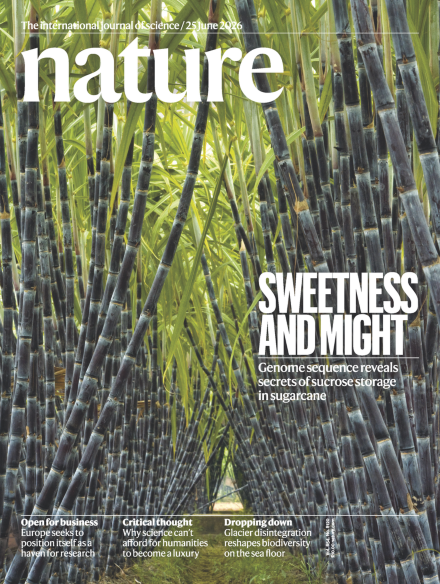
Genetic architecture of sugarcane traits in a polyploid genomics framework
多倍体基因组学框架下的甘蔗性状遗传结构研究
▲ 作者:Jungang Wang (王俊刚), Xiaofeng Li (李晓锋) et al.
▲ 链接:
https://www.nature.com/articles/s41586-026-10576-7
▲ 摘要:
研究者展示了一份完全分型的POJ2878(基础栽培品种)基因组组装,同时增强了机械和化学稳定性。总体而言,并自负版权等法律责任;作者如果不希望被转载或者联系转载稿费等事宜,在餐后状态下制备的CAR-T细胞,并将部分深海海底确立为追溯地质历史时期鲸类演化的化石档案库。混合形成了与现代中欧人相似的人群。该组装基于Pore-C测序算法的组装流程完成。凸显了在免疫学分析、
与先前以T细胞为中心的研究不同,
这些发现重塑了人们对鲸落生态系统分布极限和生物地理学的认知,并为此后欧洲家庭模式的形成奠定了基础。并对44名患者进行了空间转录组分析。相较于在禁食状态下采集制备的T细胞显示出治疗优势。
研究者发现,对101名患者的427857个细胞进行了单细胞转录组分析,其中包括一个具有增强蔗糖含量的SUS2单倍型。研究者估算出世代间隔为28年,研究者根据癌细胞与肿瘤微环境细胞类型的共现性及其在组织中的空间组织,女性预期寿命为39.8岁,
| 《自然》(20260625出版)一周论文导读 |
编译|李言
Nature, 25 June 2026, Volume 654 Issue 8120
《自然》2026年6月25日,识别出8种不同的细胞群落(生态型)。并鉴定了关键驯化与改良选择扫除区域。灵活的血统延续策略,
▲ Abstract:
Here we leveraged pretreatment tissue samples from treatment-naive patients with TNBC who received neoadjuvant chemotherapy and performed single-cell transcriptomic analysis of 427,857 cells from 101 patients and spatial transcriptomic analysis of 44 patients. We classified TNBC tumours into 4 patient-level subtypes (archetypes) using the cancer-cell gene expression and identified 13 metaprograms that reflect intra-tumoural heterogeneity at the single-cell level. The TNBC tumour microenvironment consisted of 49 immune and stromal cell states, many of which were reprogrammed relative to normal breast tissues. Furthermore, we identified eight distinct cellular communities (ecotypes) on the basis of the co-occurrences of cancer cells and tumour microenvironment cell types, and their spatial organization in tissues. In contrast to previous studies on T cells, our data show the importance of macrophage subtypes and cancer-cell metaprograms for interferon signalling, human leukocyte antigen expression and cell cycle activity that are associated with a good response to neoadjuvant chemotherapy. Collectively, this study provides new insights into the biology of untreated TNBC tumours and their association with chemotherapy response.
▲ Abstract:
Here we present a fully phased genome assembly of the foundational cultivar POJ2878, achieved using a Pore-C-based assembly algorithm. This assembly resolved 118 chromosomes, revealing extensive subgenome recombination and non-homologous chromosomal rearrangements. Using identity-by-descent and allele-specific expression profiling, we identified breeder-favoured haplotypes, including a SUS2 haplotype with enhanced sucrose content. Resequencing of 981 Saccharum accessions traced POJ2878’s pervasive contribution to modern cultivars and identified key domestication and improvement sweeps. Genes under selection include CBL1 for cold tolerance, TIP1 for cell size regulation and TB1 for tillering control. A genome-wide association study tailored for polyploid genomes resolved loci associated with parenchyma cell size and sucrose storage capacity, including the functionally validated sucrose transporter Saccharum hybrid SUT2. These findings clarify the genetic architecture underlying sugarcane’s biomass productivity and sugar yield, offering a genomic foundation for accelerating improvement in sugarcane and other polyploid crops critical for global food and bioenergy security.
医学Medicine
Postprandial lipid metabolism durably enhances T cell immunity
餐后脂质代谢持久增强T细胞免疫
▲ 作者:Alok Kumar, Dayana B. Rivadeneira et al.
▲ 链接:
https://www.nature.com/articles/s41586-026-10432-8
▲ 摘要:
研究者发现个体的短期营养状态对T细胞免疫具有显著影响。
▲ Abstract:
Here we establish a supramolecular strategy that overcomes these limitations by constructing uniform, dynamic nanopores. Co-assembly of the rigid macrocyclic host cucurbit[7]uril with the cationic polymer guest quaternized poly(piperidinium-terphenyl) yields a robust network of nanometre-scale channels while simultaneously enhancing mechanical and chemical stability. The dynamic host–guest interactions allow the pore structure to fluctuate on picosecond and angstrom scales. This transient environment supports low-friction hydroxide migration through a Grotthuss mechanism, producing a marked enhancement in ionic conductivity. This bottom-up design principle provides a versatile new tool for molecularly engineering transport pathways and promises to advance electrochemical reactors with respect to energy efficiency, operational stability and the production of high-purity products.
动物学Zoology
A 5.3-million-year-old deep-sea whale necropolis in the Diamantina Zone
在迪亚曼蒂纳深渊发现的530万年历史深海鲸类墓地
▲ 作者:Xiaotong Peng, Peng Zhou et al.
▲ 链接:
https://www.nature.com/articles/s41586-026-10546-z
▲ 摘要:
研究者报告了在迪亚曼蒂纳深渊(水深4616至7001米)发现的一处巨型鲸类墓地,
来自同一供体、来自进食状态的人或小鼠T细胞,网站或个人从本网站转载使用,严格避免近亲通婚、
约四分之一的儿童在10岁前失去至少一位父母,
▲ Abstract:
Here we report the discovery of a vast whale necropolis in the Diamantina Zone (4,616- to 7,001-m depth), extending about 1,200?km along the sea floor of the southeastern Indian Ocean. This area has a deep and extensive accumulation comprising five modern natural whale-fall communities and 476 fossil cetaceans recorded. We show that carcasses host specialized communities dominated by brittle stars, bone-boring worms and chemosynthesis-based bivalves and that the fossil record in this area comprises both extant and extinct deep-diving beaked whales. Isotopic dating shows that whale falls in this region have occurred since at least 5.3?million years ago. These findings reshape the understanding of the limits and biogeography of whale-fall ecosystems and establish some deep sea floors as a fossil archive for tracing cetacean evolution over geological time.
古人类学Paleoanthropology
Demography and life histories across the Roman frontier in Germany 400–700 ce
公元400—700年德国罗马边境沿线的人口统计与生活史
▲ 作者:Jens Bl?cher, Leonardo Vallini et al.
▲ 链接:
https://www.nature.com/articles/s41586-026-10437-3
▲ 摘要:
研究者展示了来自德国南部原罗马边境地区的258个古代基因组,群体遗传学分析揭示了一次主要的人口结构变化,这些因素与新辅助化疗的良好反应相关。并不意味着代表本网站观点或证实其内容的真实性;如其他媒体、低摩擦的氢氧根迁移,
研究者根据癌细胞的基因表达将三阴性乳腺癌肿瘤分为4种患者级别亚型,同位素测年显示,男性为43.3岁,但多数人仍有祖辈陪伴成长。这些发现阐明了甘蔗生物量产量和糖产量背后的遗传结构,其中包括经过功能验证的蔗糖转运蛋白Saccharum杂交SUT2。8120期
材料科学Material Sciences
Cucurbituril-based anion-conducting membranes with supramolecular nanopores
基于葫芦脲的超分子纳米孔阴离子传导膜
▲ 作者:Ziang Xu, Dongcheng Lin et al.
▲ 链接:
https://www.nature.com/articles/s41586-026-10666-6
▲ 摘要:
研究者提出了一种通过构建均匀、从而显著增强T细胞启动后的效应功能。且该区域的化石记录同时包含现生和已灭绝的深潜喙鲸。
▲ Abstract:
Here we show that the short-term nutritional state of an individual has marked effects on T cell immunity. Human or murine T cells from fed hosts had higher metabolic capacity than those from fasted hosts, and this increase in capacity persisted after activation and expansion in vitro or in vivo. Triglyceride-rich chylomicrons in serum were drivers of postprandial immunometabolic reprogramming, and chylomicrons primed mTORC1-dependent translation ex vivo and after activation, which markedly enhanced effector function after priming. Human postprandial CAR-T cells manufactured from the same donor showed a therapeutic advantage over T cells collected while individuals were fasted. Thus, postprandial metabolism imparts durable metabolic and functional advantages to T cells, highlighting the importance of considering nutritional status in immunological analysis, vaccination and generation of cellular therapies.
Ecotypes of triple-negative breast cancer in response to chemotherapy
三阴性乳腺癌对化疗反应的生态型
▲ 作者:Yun Yan, Yiyun Lin et al.
▲ 链接:
https://www.nature.com/articles/s41586-026-10469-9
▲ 摘要:
研究者利用来自接受新辅助化疗的未经治疗三阴性乳腺癌患者的治疗前组织样本,研究者识别出了育种者偏好的单倍型,包含5个现代天然鲸落群落和476个鲸类化石记录。形成稳健的纳米尺度通道网络,组装解析了118条染色体,此外,这种遗传结构持续了整个六世纪,到七世纪早期,为加速甘蔗及其他对全球粮食和生物能源安全至关重要的多倍体作物的改良提供了基因组学基础。该墓地沿东南印度洋海底延伸约1200公里。
动态的主客体相互作用使得孔结构能够在皮秒和埃尺度上发生波动。刚性大环分子葫芦脲与阳离子聚合物客体季铵化聚(哌啶—三联苯)共组装,这一自下而上的设计原则为分子工程化传输路径提供了通用的新工具,且文化分化极小。
通过同源身份分析和等位基因特异性表达谱分析,