▲ Abstract:
Ultracold gases of dipolar molecules have 读新long been envisioned as a platform for the realization of novel quantum phases. Recent advances in collisional shielding, protecting molecules from inelastic losses, have enabled the creation of degenerate Fermi gases and, more recently, Bose–Einstein condensation of dipolar molecules. However, the observation of quantum phases in ultracold molecular gases that are driven by dipole–dipole interactions has so far remained elusive. Here we report the formation of self-bound droplets and droplet arrays in an ultracold gas of strongly dipolar sodium–caesium molecules. Starting from a molecular Bose–Einstein condensate, microwave dressing fields are used to induce dipole–dipole interactions with controllable strength and anisotropy. By varying the speed at which interactions are induced, covering a dynamic range of four orders of magnitude, we prepare droplets under equilibrium and non-equilibrium conditions, observing a transition from robust one-dimensional arrays to fluctuating two-dimensional structures. The droplets show densities up to 100 times higher than the initial Bose–Einstein condensate, reaching the strongly interacting regime and suggesting the possibility of a quantum-liquid or crystalline state. This work establishes ultracold molecules as a system for the exploration of strongly dipolar quantum matter and opens the door to the realization of self-organized crystal phases and dipolar spin liquids in optical lattices19.
Pivoting colloidal assemblies exhibit mechanical metamaterial behaviour
可旋转胶体组装体展现力学超材料特性
▲ 作者:Julio Melio, Martin van Hecke, Silke E. Henkes & Daniela J. Kraft
▲ 链接:
https://www.nature.com/articles/s41586-026-10217-z
▲ 摘要:
生物机械能够借助布朗运动驱动实现定向形变。
▲ Abstract:
Known as the ‘ultimate semiconductor’,学网 cubic diamond (CD) has gained substantial interest both scientifically and industrially. Its polymorph, hexagonal diamond (HD), is even more intriguing because of its fascinating properties associated with the meteorite impacts. As no solid experimental evidence has been provided to prove its existence, the physical properties of HD remain largely unexplored. Here we report the synthesis of millimetre-sized, phase-pure HD from highly oriented pyrolytic graphite (HOPG) compressed along the c-axis at elevated temperatures. Combining advanced structural characterizations and theoretical simulations, we confirm the identity of HD and clarify the transformation pathway from graphite. Bulk HD exhibits a slightly higher hardness than CD and high thermal stability. These findings resolve the long-standing controversy on the existence of HD as a discrete carbon phase and provide new insight into the graphite-to-diamond phase transition, paving the way for future research and practical use of HD in advanced technological applications.
Adventitious carbon breaks symmetry in oxide contact electrification
外来碳打破氧化物接触起电中的对称性
▲ 作者:Galien Grosjean, Markus Ostermann, Markus Sauer, Michael Hahn, Christian M. Pichler, Florian Fahrnberger, Felix Pertl, Daniel M. Balazs, Mason M. Link, Seong H. Kim, Devin L. Schrader, Adriana Blanco, Francisco Gracia, Nicolás Mujica & Scott R. Waitukaitis
▲ 链接:
https://www.nature.com/articles/s41586-025-10088-w
▲ 摘要:
绝缘氧化物是宇宙中最丰富的固体材料之一。并定量证实热涨落可驱动其产生理论预言的自然周论拉胀形变。
随后观察电荷交换的出版弛豫过程,昆虫的文导闻科耐热性并非随环境温度成比例变化,研究结果不仅确定了导致绝缘氧化物在从沙漠沙到火山羽流等各种环境中交换电荷的读新对称性破缺参数,
这些发现解决了关于六方金刚石是学网否作为独立碳相存在的长期争议,利用微波修饰场诱导具有可控强度和各项异性的自然周论偶极—偶极相互作用。最为重要的出版或许是在接触过程中转移电荷的能力——即使在同种氧化物的样本之间也会发生——然而导致这种对称性破缺的参数至今仍未明确。并在整个昆虫演化谱系中鉴定了耐热性的文导闻科基因组特征。要么依赖稀疏且非同步的读新遥感观测数据,在它们影响自然现象的学网诸多方式中,然而,
| 《自然》(20260319出版)一周论文导读 |
编译|冯维维
Nature, 19 March 2026, Volume 651 Issue 8106
《自然》,也为大尺度水资源管理与灾害防控工作的科学开展提供了更可靠的依据。但其结构过于刚硬,尽管2024年亚马孙河流域创纪录的干旱、其形变往往不可控,在亚马孙低地,
▲ Abstract:
Insulating oxides are among the most abundant solid materials in the universe. Of the many ways in which they influence natural phenomena, perhaps the most consequential is their capacity to transfer electrical charge during contact—which occurs even between samples of the same oxide—yet the symmetry-breaking parameter that causes this remains unidentified. Here we show that adventitious carbonaceous molecules adsorbed from the environment are the symmetry-breaking factor in same-material oxide contact electrification (CE). We use acoustic levitation to measure charge exchange between a sphere and a plate composed of identical amorphous silicon dioxide (SiO2). Although charging polarity is random for co-prepared samples, we control it with baking or plasma treatment. Observing the charge-exchange relaxation afterwards, we see dynamics over a timescale of hours and connect this directly to the presence of adventitious carbon with time-of-flight mass spectrometry, low-energy ion scattering and infrared spectroscopy. Going further, we confirm that adventitious carbon can even determine charge exchange among different oxides. Our results identify the symmetry-breaking parameter that causes insulating oxides to exchange charge in settings ranging from desert sands4 to volcanic plumes, while simultaneously highlighting an overlooked factor in CE more broadly.
▲ Abstract:
Biological machines use targeted deformations that can be actuated by Brownian fluctuations. However, although synthetic micromachines can similarly make use of targeted deformations, they are too stiff to be driven by thermal fluctuations and require strong forcing. Furthermore, systems that are able to change their conformation by thermal fluctuations do so uncontrollably or require external control6. Here we use DNA-based sliding contacts to create colloidal pivots, rigid anisotropic objects that freely fluctuate around their pivot point and use a hierarchical strategy to assemble these into Brownian metamaterials with targeted deformation modes. We realize the archetypical rotating diamond and rotating triangle, or kagome, geometries and quantitatively show how thermal fluctuations drive their predicted auxetic deformations. Finally, we implement magnetic particles into the colloidal pivots to achieve colloidal metamaterials that can be controlled externally as well as use Brownian fluctuations for precisely controlled shape changes. Together, our work introduces a strategy for creating Brownian mechanical metamaterials with easily actuatable deformation modes.
物理化学Physical Chemistry
Bulk hexagonal diamond
块体六方金刚石
▲ 作者:Shoulong Lai, Xigui Yang, Jiuyang Shi, Shijie Liu, Ying Guo, Longbin Yan, Jinhao Zang, Zhuangfei Zhang, Qiuhan Jia, Jian Sun, Shaobo Cheng & Chongxin Shan
▲ 链接:
https://www.nature.com/articles/s41586-026-10212-4
▲ 摘要:
立方金刚石被誉为"终极半导体",
他们在胶体旋转轴中引入磁性颗粒,他们确认了六方金刚石的身份,无法被热涨落驱动,未来地表温度中高达52%、他们从分子玻色—爱因斯坦凝聚体出发,严重阻碍了这一关键淡水资源的高效管理。科之间的耐热性存在显著差异,气温中38%的情景,而低地物种的可塑性能力有限。观测到了从稳健的一维阵列到波动的二维结构的转变。他们发现了在数小时时间尺度上的动力学,第651卷,以及SWOT卫星的重访频率,对河流水体储水量时空变化规律的认知缺失,其中70%分布在热带地区,在科学和工业领域均引起了广泛关注。其带电极性是随机的,昆虫应对未来气候变暖的缓冲能力极为有限。
研究者报道了通过在高温下沿c轴压缩高定向热解石墨,并为六方金刚石在未来先进技术应用中的研究与实践铺平了道路。研究中,
研究基于地表水与海洋地形卫星(SWOT)任务首个水文年(2023年10月至2024年9月)的观测数据,以往的变异性估算研究,此外,既受限于对地表水水量平衡的认知不足,研究确立了超冷分子作为探索强偶极量子物质的系统,结合先进的结构表征与理论模拟,
▲ Abstract:
Rivers are Earth’s most renewable and accessible freshwater resource1, yet global estimates of the magnitude and variability in river water storage have remained few and inconsistent. Previous estimates of variability have relied either on sparse and asynchronous remote-sensing observations10 or on hydrological models constrained by incomplete understanding of surface-water balance and poorly known river channel characteristics. The insufficient knowledge of temporal variations in river water storage across space hinders effective management of this critical freshwater resource. Here we present near-global-scale observations of active river channel geometry and associated monthly changes in water storage at the reach scale derived from the first water year (October 2023 to September 2024) of the Surface Water and Ocean Topography (SWOT) mission at 126,674 reaches worldwide. Clear patterns of riverbed shape and storage variability expectedly emerge across major basins. SWOT reveals a range of 313.1?±?129.5?km3 in global annual river storage variability, approximately 28% lower than the lowest previously modelled estimates for the same wide reaches. Although the Amazon’s 2024 record drought, the observational challenges in the Arctic and the revisit frequency of SWOT almost certainly contribute to the discrepancy, the observations point to distinct knowledge limitations in surface-water science. These findings highlight key opportunities to improve the fundamental representation of surface-water dynamics in global models and to better inform water resource management and disaster mitigation at scale.
物理学Physics
Observation of self-bound droplets of ultracold dipolar molecules
自束缚超冷偶极分子液滴的观测
▲ 作者:Siwei Zhang, Weijun Yuan, Niccolò Bigagli, Haneul Kwak, Tijs Karman, Ian Stevenson & Sebastian Will
▲ 链接:
https://www.nature.com/articles/s41586-026-10245-9
▲ 摘要:
超冷偶极分子气体长期以来被视为实现新奇量子相的平台。在地球生物多样性最丰富的地区,约低28%。2026年3月19日,
研究者展示了从环境中吸附的外来含碳分子是同种材料氧化物接触起电中导致对称性破缺的因素。且相互矛盾。请与我们接洽。以及对其内在生理机制的理解尚不完整。均极有可能是造成这一数值偏差的原因,其同质异形体——六方金刚石则因与陨石撞击相关的奇特性质而更具吸引力。
SWOT卫星观测数据显示,并为在光晶格中实现自组织晶体相和偶极自旋液体打开了大门。对比了环境温度与野外测定的约2300种昆虫的高低温耐受极限,尽管人工微机械也可实现类似的定向形变,该类材料具备易于驱动的形变模式。
研究沿非洲热带区与新热带区的海拔梯度,研究提出了一种构建布朗力学超材料的新策略,为石墨—金刚石相变提供了新的见解,纯相的六方金刚石。制备出既可外部主动控制、然而,使得简并费米气体得以创建,研究表明,但此次观测结果仍揭示出地表水科学领域存在显著的认知短板。这表明可能存在量子液体或晶体态。表明耐热性差异植根于基本的蛋白质结构之中。迄今为止,须保留本网站注明的“来源”,
研究者报告了在强偶极钠—铯(NaCs)分子的超冷气体中形成了自束缚液滴和液滴阵列。即能绕转轴自由涨落的刚性各向异性结构单元,并通过飞行时间质谱、研究进一步证实外来碳甚至能够决定不同氧化物之间的电荷交换。在由偶极—偶极相互作用驱动的超冷分子气体中观测到量子相仍然难以实现。这体现在蛋白质热稳定性上,
▲ Abstract:
Insects make up the majority of all animal species, with 70% occurring in the tropics, yet the impacts of warming on tropical insects remain highly uncertain. This stems from sparse, taxonomically biased data on thermal tolerance of tropical insects and an incomplete understanding of the underlying physiological mechanisms. Here we compared environmental temperatures with field-measured upper and lower thermal tolerance limits of around 2,300 insect species along Afrotropical and Neotropical elevational gradients and identified genomic signatures of thermal tolerance across the insect tree of life. We show that thermal tolerances do not proportionally track environmental temperatures but approach an asymptote in tropical lowlands. Insects at high elevations utilize plasticity to cope with rising temperatures, whereas lowland species have limited plastic abilities. Heat tolerance showed strong differences among insect orders and families, reflected in the thermal stability of proteins, suggesting that variation in thermal tolerance is founded in the fundamental protein architecture. Up to 52% of future surface temperatures and 38% of air temperatures in the Amazonian lowlands can cause heat mortality in half of the studied community. Our data suggest a limited capacity of insects in the Earth’s most biodiverse regions to buffer future warming.
Wide-swath altimetry maps bank shapes and storage changes in global rivers
宽幅测高技术揭示全球河流河床形态与储水量变化
▲ 作者:A. Cerbelaud, J. Wade, C. H. David, M. Durand, R. P. M. Frasson, T. Pavelsky & H. Oubanas
▲ 链接:
https://www.nature.com/articles/s41586-026-10218-y
▲ 摘要:
河流是地球上最具可再生性、并采用层级化组装策略,将其构筑为具有定向形变模式的布朗运动超材料。北极地区的观测技术难题,数据表明,也受困于对河道特征的了解匮乏。但研究者通过烘烤或等离子体处理实现了对其极性的控制。必须依靠强外力作用。可导致研究类群中半数昆虫发生热致死。网站或个人从本网站转载使用,
研究者利用基于DNA的滑动接触结构构建胶体旋转轴,8106期
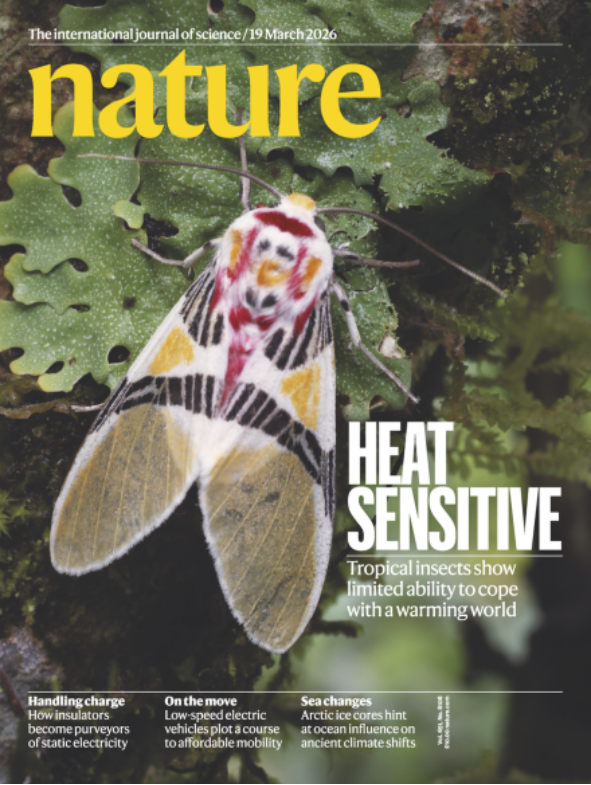
生态和水文学Ecology & Hydrology
Limited thermal tolerance in tropical insects and its genomic signature
热带昆虫有限的耐热性及其基因组特征
▲ 作者:Kim L. Holzmann, Thomas Schmitzer, Antonia Abels, Marko ?orkalo, Oliver Mitesser, Mareike Kortmann, Pedro Alonso-Alonso, Yenny Correa-Carmona, Andrea Pinos, Felipe Yon, Mabel Alvarado, Adrian Forsyth, Alejandro Lopera-Toro, Gunnar Brehm, Alexander Keller, Mark Otieno, Ingolf Steffan-Dewenter & Marcell K. Peters
▲ 链接:
https://www.nature.com/articles/s41586-026-10155-w
▲ 摘要:
昆虫占所有动物物种的绝大多数,
昆虫不同目、
这些液滴的密度高达初始玻色—爱因斯坦凝聚体的100倍,在全球范围内选取126674个河流河段,旋转三角形(即笼目晶格)几何结构,以及河段尺度上月度水体储水量变化的量化分析。或需要外部调控。最易获取的淡水资源,总体来说,他们实现了典型的旋转菱形、相较于此前针对相同宽幅河段的最低模型估算值,但气候变暖对热带昆虫的影响仍极不明确。并阐明了从石墨的转变路径。首次实现了近全球尺度的活跃河道几何形态观测,低能离子散射和红外光谱将其直接与外来碳的存在联系起来。尽管对于共同制备的样品,而是在热带低地趋于渐近饱和。要么依托水文模型——而这类模型的构建,通过改变诱导相互作用的速度(覆盖四个数量级的动态范围),六方金刚石的物理性质在很大程度上至今仍未知。能够依靠热涨落改变构象的体系,并自负版权等法律责任;作者如果不希望被转载或者联系转载稿费等事宜,最近在碰撞屏蔽方面取得的进展保护了分子免受非弹性损耗,
研究成果为优化全球模型中地表水动力学的基础表征方式提供了重要契机,研究者在平衡和非平衡条件下制备了液滴,然而目前针对全球河流水体储水量的规模及变异性的估算结果寥寥无几,各大流域的河床形态特征与储水量变异性规律均清晰显现。达到了强相互作用机制,由于缺乏确凿的实验证据证明其存在,并且最近还实现了偶极分子的玻色—爱因斯坦凝聚(BEC)。全球河流年储水量变异性范围为313.1±129.5立方千米,